Home › Commercial Gravel-to-Asphalt Conversions
Turn dusty, uneven gravel areas into clean, professional pavement with commercial gravel to asphalt conversions in Denver, CO. We evaluate your base, correct drainage issues, and pave a durable asphalt surface that reduces maintenance and improves the look of your property.
Precision Asphalt Denver provides professional commercial gravel to asphalt throughout Denver, CO, Colorado and the surrounding area. Our licensed, insured crew delivers safe, clean, on-time work with a free estimate before anything begins. Call (720) 807-8328 or request your free quote.
Commercial Gravel-to-Asphalt Conversions in Denver
If your commercial lot is still gravel, you already know the problems: dust on every vehicle, ruts after every storm, and constant grading bills. Precision Asphalt Denver helps businesses move from gravel to asphalt in a way that actually holds up to Colorado use and weather. Our commercial gravel to asphalt work focuses on drainage, base strength, and traffic patterns so you get a paved surface that stays smooth instead of breaking up in a few winters.
Most of our Denver area customers come to us because gravel is causing specific issues. Retail centers and medical offices are tired of mud tracked into buildings. Industrial yards are dealing with washboards and potholes that beat up forklifts and delivery trucks. Property managers are getting complaints from tenants about dust and uneven walking surfaces. We design the conversion around those real problems, not a one-size-fits-all layout.
When we look at your gravel lot, we do more than measure square footage. We check how water moves now, where trucks turn and sit, and what subsoil we are working with. Fill along the Front Range can vary from clay pockets to rocky material on the same site, and that affects how we build the base. Precision Asphalt Denver uses this site-specific information to recommend the right asphalt thickness, base section, and drainage plan for your property instead of guessing from a standard chart.
We also explain how the conversion will affect your operations during construction. Many businesses in Denver cannot fully shut down, so we plan phasing and access routes so customers, staff, and trucks can still reach the building. You will know in advance which entrances will be open when, how long each section will be out of service, and what temporary signage or gravel access we will put in place.
Step-by-step: How We Convert Gravel Lots to Asphalt
Turning a commercial gravel lot into a paved surface is more than just spreading asphalt over the top. If the base is not built correctly, the lot will rut and crack quickly, especially with Denver freeze-thaw cycles. Precision Asphalt Denver follows a clear process so your new pavement actually lasts.
First, we perform a site evaluation. We identify soft spots, document drainage paths, mark utilities, and map traffic flows. If needed, we bring in a geotechnical engineer for soil testing on heavier-use sites like warehouse yards or bus lots. This helps us know if we must undercut and replace weak subgrade, or if we can compact and work with what is there.
Second, we shape and compact the subgrade. Existing gravel is regraded to create proper slopes then we compact in multiple passes using vibratory rollers. Any pumping or deflection during rolling tells us where the subgrade is weak and needs excavation and replacement with structural fill.
Third, we build the base course. In Denver, that usually means 4 to 8 inches of Class 6 or similar aggregate base, placed in 2 to 3 lifts and compacted to the required density. For truck lanes and dumpster pads, we often thicken the base or use a more angular aggregate to handle the higher loading. The base is fine-graded to match final elevations so asphalt thickness is consistent.
Fourth, we install any needed drainage structures. This can include trench drains at loading docks, additional catch basins, or French drains along buildings. We adjust slopes so water moves to these inlets instead of pooling in traffic areas. On older gravel yards that have simply been “crowned” for years, this step alone can solve long-standing puddle problems.
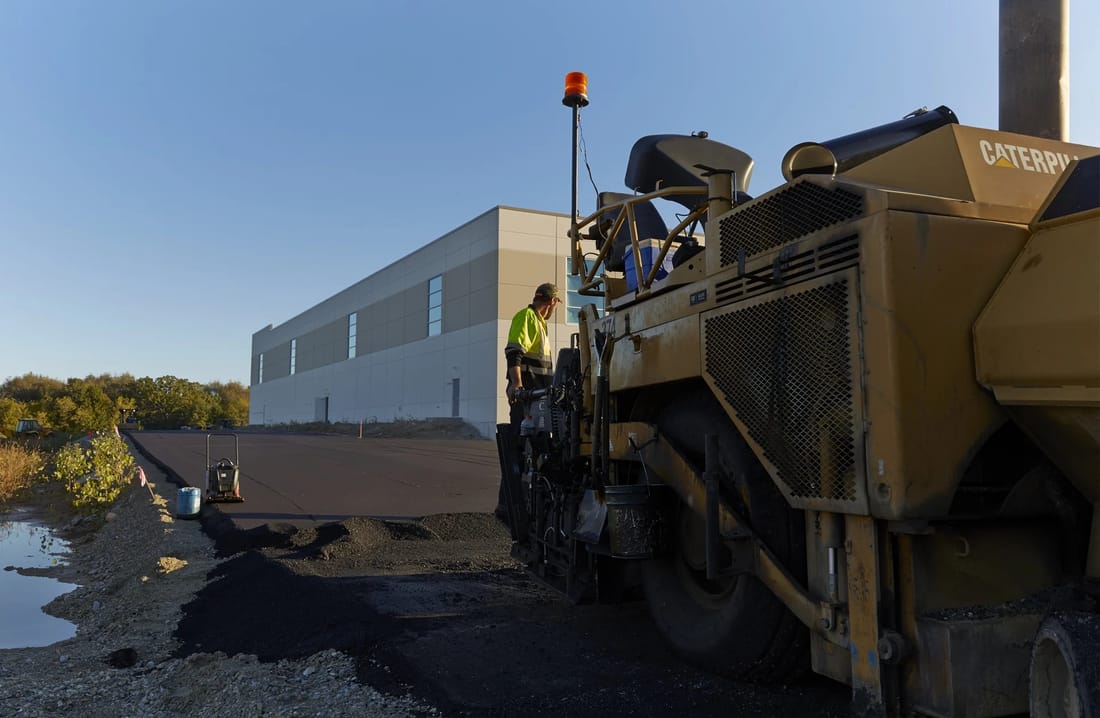
Finally, we place and compact the asphalt. We typically use a mechanical paver for commercial gravel to asphalt conversions, even on smaller jobs, so mat thickness is uniform. The mix is placed in one or more lifts depending on design thickness, then compacted with steel and pneumatic rollers. Joints with existing asphalt are saw cut and tacked so there is a tight bond and no visible seam line once striping is complete.
Material Options, Thickness, and Design Choices
Not every commercial gravel to asphalt job calls for the same pavement structure. Precision Asphalt Denver walks you through realistic options based on actual traffic and budget rather than selling the heaviest or lightest section by default.
For light duty applications such as employee parking, small retail lots, and churches, we often recommend a 3 to 4 inch total asphalt thickness over a 4 to 6 inch aggregate base. This balances cost and performance for cars and light trucks. For moderate duty, such as busy shopping centers or small delivery fleets, we may increase asphalt to 4 to 5 inches and the base to 6 to 8 inches to handle more frequent loading.
Heavy duty areas, like trash truck routes, semi truck loading zones, and fire lanes, are designed differently from car parking. We usually specify thicker asphalt sections, a stronger base, or both. In some cases, we pour reinforced concrete pads only where truck wheels track, and tie that into the surrounding asphalt, so you do not overbuild the entire lot when only a few lanes see extreme loads.
Material type matters too. In Denver, we select asphalt mixes with enough binder content and the right aggregate for freeze-thaw and UV exposure. For gravel conversions, we often use a stronger base mix on the bottom lift, then a finer surface mix for the top that gives better appearance and striping definition. On steeper drive lanes that can ice up in winter, we can specify a slightly coarser surface texture for better traction without making snow removal difficult.
We also talk openly about finish choices. Some Denver owners want a very dark, clean look with sharp striping to improve property image. Others focus on function and heavy-duty performance. We can include concrete curb and gutter, bollards, wheel stops, and loading dock aprons as part of the design so everything works together, instead of piecing those in after the asphalt is already placed.
Cost Drivers, Timelines, and Common Denver Issues
Many owners ask why converting gravel to asphalt sometimes costs more than they expected. Most of that comes down to what is beneath the gravel and how much structural work is needed. Precision Asphalt Denver explains these cost drivers up front so there are fewer surprises once work starts.
Subgrade conditions are the biggest factor. If your gravel lot has been collecting water for years, the soil below may be soft and saturated. We may need to undercut those areas and replace them with compacted structural fill or use geogrid to keep the base from punching into the subgrade. That adds material and labor, but it is often the difference between a lot that lasts decades and one that fails in a couple of winters.
Drainage improvements are another major cost item. A flat gravel yard that has always been muddy will not magically drain once it is paved. We often have to adjust slopes, rebuild swales, or add catch basins and piping. Denver’s quick storm events can dump a lot of water in a short time, so we design slopes and inlets to move water off the surface quickly and away from entrances and loading docks.
Access and phasing can also affect cost and schedule. If we can close the lot and work in a single push, mobilization is simpler and the timeline is shorter. If the property must stay open, we break the project into phases, which may add days to the schedule for curing, traffic control, and re-striping. Mixed use sites near downtown Denver or along busy corridors often need more flaggers, cones, and temporary signage than suburban sites, and that is part of the pricing.
Weather is another local issue. Along the Front Range, we have wide temperature swings and sudden storms. We plan commercial gravel to asphalt work during windows when we can compact and cool the asphalt correctly, usually spring through fall. If you are on a tight deadline, it helps to contact us early so we can reserve production slots in those better months.
What to Expect When You Work With Precision Asphalt Denver
Before any contract is signed, we start with an on-site meeting. We walk the gravel lot with you, listen to how your property works day to day, and look at where existing problems show up. You get a written proposal that spells out pavement sections, drainage work, phasing, and any allowances for unknowns like buried debris or saturated pockets.
Once scheduled, we coordinate with your tenants, staff, or operations team. Precision Asphalt Denver provides a clear calendar that shows when each section of the lot will be closed, when access will move, and when striping will be complete. For retail or medical sites, we usually keep main entrances open and work on secondary areas first. For industrial yards, we schedule around truck delivery windows as much as possible.
During construction, you will see compaction tests and layout checks, not just trucks coming and going. Our crews check base density, slope to drains, and asphalt thickness as we go. If we uncover unexpected poor soil or hidden structures in the gravel, we show you and present options with cost and schedule impacts before we proceed.
After the asphalt is in and striping is complete, we walk the site with you again. We point out joint locations, drainage paths, and high stress areas so you know what to watch over time. We also outline a simple maintenance plan: how soon to allow heavy trucks, when sealing might be appropriate, and which de-icing products are safest for your new pavement. The goal is that your commercial gravel to asphalt conversion is not just a one-time project, but a reliable surface that serves your property for many years in Denver’s climate.